
FAQs
Click through to learn the answers to common solar questions.
How Solar Works
How does a solar farm work?
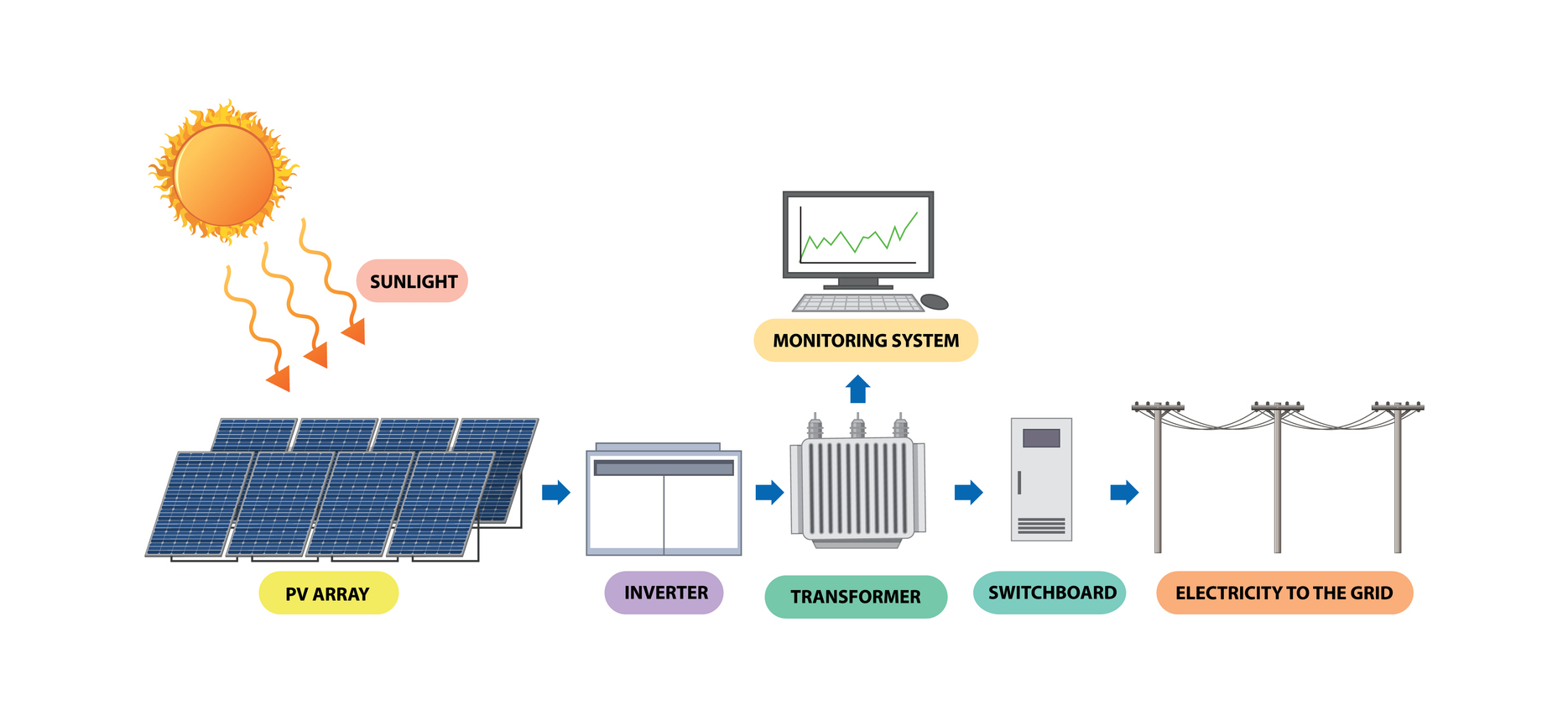
As sunlight hits the solar panels, the solar radiation is converted into direct current (DC) electricity.
The direct current is collected on cables from each “string” of panels and flows into power inverters, where it is converted into alternating current (AC) electricity, which is suitable for use by homes and businesses.
The AC electricity from the power inverters is again collected using a series of cables and delivered to a central electrical substation, where it passes through a power transformer. The transformer boosts the voltage of the current to match the voltage at the point of delivery at the local utility substation.
The local utility distributes electricity to homes and businesses along its electrical grid.
Land and Water
Do solar facilities pollute the ground or water?
No. Solar projects do not generate air or water emissions or hazardous waste during their operations.
Crystalline silicon panels represent approximately 90 percent of solar panels in use today. Research has shown that they “do not pose a material risk or toxicity to public health and safety.” (“Health and Safety Impacts of Solar Photovoltaics,” N.C. State University, N.C. Clean Energy Technology Center, May 2017)
Even if damaged, the solar cell will not shatter or create debris, just like a windshield may crack but stay intact.
Economics
How does a solar project affect a local community? What are the economic benefits from a solar project?
Depending on the site, solar projects are located on land that generates relatively little tax revenue and, in some cases, little revenue overall. Additionally, solar projects utilize minimal public infrastructure (water, sewer, schools, police, and first responders) relative to commercial or residential development, so the cost to the locality is typically very low. Utility-scale solar projects create local construction jobs and increase business and revenue for local services such as local suppliers, stores, restaurants, and hotels. The projects also create a small number of permanent jobs for vegetation management, along with the general options and maintenance of the facility.
Additionally, solar projects provide revenue to local landowners in the form of lease payments, enabling them to retain the economic viability of their land, as well as to ensure that it is retained as farmland (assuming the land is farmland) for generations to come. Farmers appreciate the economic stability that comes with a solar project, which can balance out the cyclical and often inconsistent revenue that comes from farming.
What happens if Heelstone goes out of business or bankrupt?
Our projects – and your community – are protected in the highly unlikely event that we would be financially incapable of continuing to operate. Each project stands on its own merits as a viable business and is secured by the equipment, which costs millions of dollars. Beyond that, it is possible that the project and its equipment would be sold to another developer. If that happens, the new ownership is responsible for honoring all land rights and easement agreements – as well as meeting our decommissioning commitments with landowners.
Other Questions and Concerns
What does decommissioning look like?
More than 85 percent of a solar PV module is made of materials that we already know how to recycle, like aluminum and glass. The challenge is making the recycling of solar equipment economic. As more and newer panels come online, the economics of deconstructing and recycling solar are expected to improve significantly.
To the extent possible, project equipment will be reconditioned, resourced, and/or recycled. For example, solar panels typically consist of glass, polymer, aluminum, copper, and semiconductor materials that can be recovered and recycled at the end of their useful life. Any materials that cannot be recycled are safely disposed of at approved facilities.
Will the panels cause glare or reflection?
Photovoltaic panels are constructed with non-reflective coatings, glass, or other materials. These panels are designed to absorb as much sunlight as possible to maximize electrical generation, rather than reflecting sunlight. Additionally, the metal supports that form the racking system are typically constructed using galvanized steel or aluminum.
All of our systems are designed with great care to ensure that glint and glare are eliminated or kept to an absolute minimum.